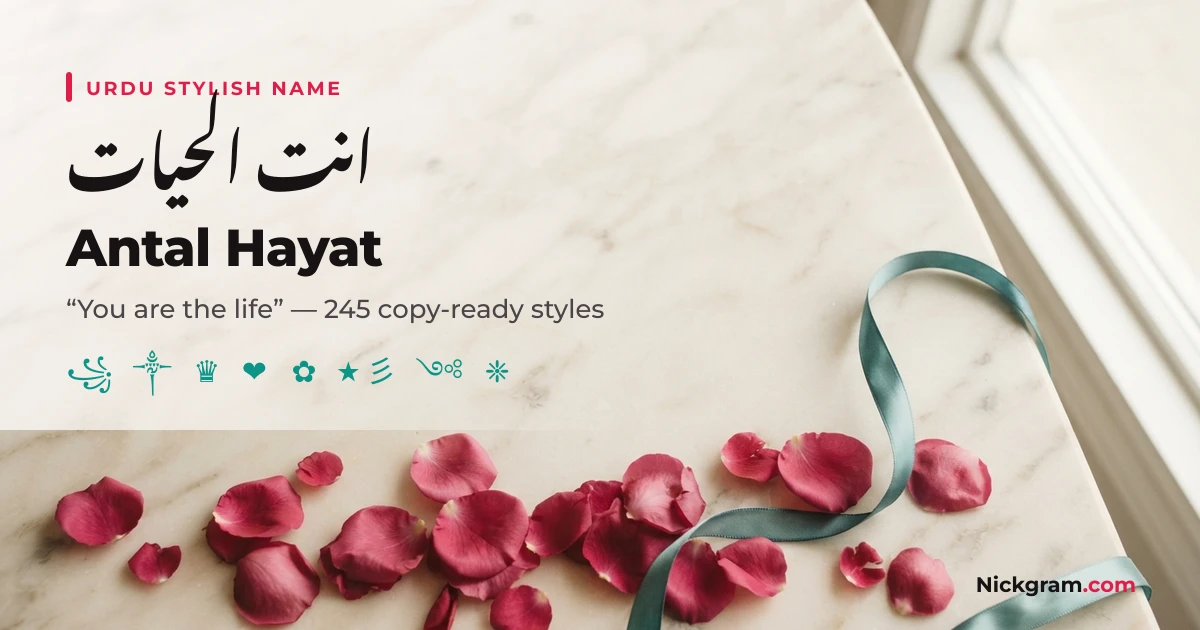
انت الحیات (Antal Hayat) is an Arabic phrase meaning “you are the life” — and it is one of the most-copied Urdu-script display names on Nickgram. It is a phrase, not a personal name, which is why people use it for a partner, a profile bio, or a caption rather than as their own given name. Because it is written in Arabic script you cannot change its letterforms the way you can with English; a “stylish انت الحیات name” is the phrase itself framed with symbols. It travels well too — the same string works as an imo or WhatsApp profile name, an Instagram display name, or an in-game name in Free Fire, PUBG Mobile and Mobile Legends: Bang Bang. All 245 versions below are ready to copy — tap any one, or type your own word into the generator at the top of the page.
انت الحیات stylish name — copy sets
Ordered from the simplest frame to the most decorated. Short frames survive the character limits on WhatsApp and Instagram; the long ones suit a Facebook nickname field or an imo profile where you have more room.
Heart and love frames
The phrase already carries a romantic meaning, so these are the sets people copy most often for a partner’s name or a couple bio.
Royal and bold frames
Decorative and floral frames
What انت الحیات means — and the spelling everyone copies
The phrase means “you are the life.” It breaks into two parts: انت (anta / anti) meaning “you”, and الحیات (al-hayat) meaning “the life”. Put together it reads as a declaration — you are my life — which is why it spread as a couple name rather than a personal one.
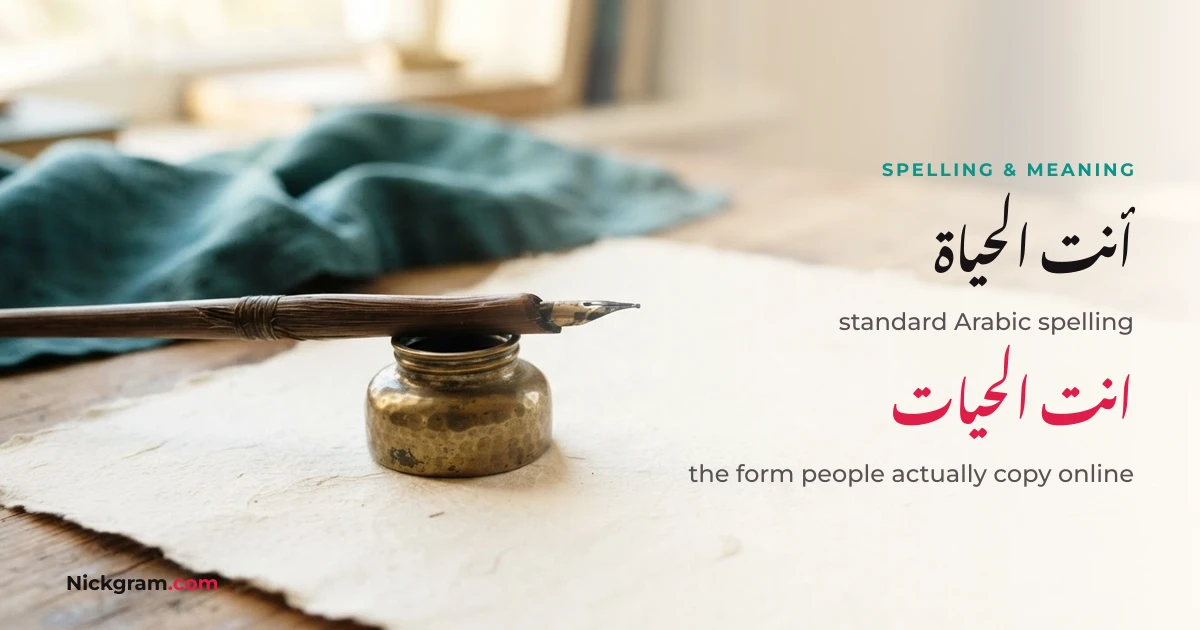
Here is the detail almost nobody mentions, and it matters if you care about writing it correctly. The standard Arabic spelling is أنت الحياة. The version that circulates online — the one in every copy list, including this page — is انت الحیات, and it differs in three small ways:
- The hamza above the first letter is dropped: ا instead of أ. Very common in casual typing.
- It uses ی (the Urdu/Persian yeh, U+06CC) instead of Arabic ي — a sign it is being typed on an Urdu keyboard.
- It ends in ت rather than ة (taa marbuta), which is how the word is often written when it is treated as a borrowed phrase rather than as Arabic grammar.
None of these make it “wrong” for a display name — it is what people search for and what they recognise. But if you are putting the phrase somewhere formal, أنت الحياة is the spelling to use. Both forms are in the copy sets above so you can pick.
Related phrases people copy alongside it
These are near neighbours in meaning, useful when you want the same feeling without the exact same string as everyone else.
انت حیاتی shifts the meaning slightly to “you are my life” — the ی at the end is the possessive. If you want the phrase to be about one specific person rather than a general statement, this is the one to use.
Antal Hayat in English letters
Some apps still refuse Arabic script in a username field, and some people simply prefer the Roman spelling. Unlike Arabic script, Latin letters can be swapped for Unicode look-alikes, so these versions really do change shape:
A caution on these: the fancy Latin versions are mathematical alphanumeric characters, not a font. They keep their look anywhere Unicode is supported, but a screen reader will read them out letter by letter or skip them entirely, and search inside an app will not match them against ordinary letters.
Why brackets sometimes jump to the wrong side
This trips up almost everyone who decorates Arabic or Urdu text, and it is not a bug in your phone.
Arabic script runs right to left, while brackets and symbols have no direction of their own — so the app decides where to put them based on the text around them. Paste ꧁انت الحیات꧂ into a box that is set to left-to-right and the two halves of the frame can appear to swap sides, or the whole thing can shift when you add an English word next to it.
Three practical ways around it:
- Use symmetrical frames. ❤︎ ❤︎ or ✿ ✿ look the same either way round, so a flip is invisible. Directional pairs like ◤ ◥ or 『 』 are the ones that betray you.
- Keep the whole name in one script. Mixing
انت الحیاتwith English words in the same field is what triggers most reordering. - Check it in the actual app before saving. The same string can lay out differently in imo, WhatsApp and a game profile because each one sets text direction its own way.
Where this name works
Arabic-script display names are accepted in more places than people expect. The table below is what we can state honestly: which fields take the script, and the constraint that actually bites in each one. We have deliberately not printed character limits as hard numbers — they differ by app version and region, and a number copied from an old article is worse than no number. Check the counter in the app itself.
| Where | Takes Arabic script? | What to watch for |
|---|---|---|
| imo profile name | Yes | The most common destination among our visitors. Long frames may be truncated in chat lists. |
| WhatsApp name | Yes | Tight limit — use a short frame. The About field is far roomier. |
| Instagram display name | Yes | Limited changes in a rolling window. The @username will not take it. |
| Facebook name | Restricted | Real-name policy rejects decorative symbols. Use the bio instead. |
| Free Fire / PUBG Mobile | Mixed | Renames are paid. Test a short frame before spending anything. |
| Mobile Legends: Bang Bang | Mixed | Filters vary by server. Same advice — try short first. |
| Any @username or email | No | Latin letters, digits and a couple of punctuation marks only. |
See the full imo name style set if imo is where this is going.
Symbols and frames to copy
Copy these one at a time and build your own frame around the phrase — or around any other word.
Kaomoji to pair with the name
These sit well after an Arabic-script name because they are built from ordinary punctuation — no right-to-left reordering, and they render on almost anything.
How to build your own انت الحیات name
- Copy the phrase first, before adding anything. Arabic script is hard to type on a Latin keyboard, so start from a clean copy.
- Pick one symmetrical frame from the sets above and put it on both sides.
- Add at most one accent — a single ❤︎ or ♛ reads as a choice; four of them read as clutter and eat your character limit.
- Paste into the real field and look at it before you save. Check the frame did not flip and nothing turned into an empty box.
- If a box appears, that device is missing the font for that symbol. Swap that one symbol out — the Arabic text itself is almost never the problem.
Which spelling is correct — انت الحیات, انت الحیاۃ or أنت الحياة?
All three are the same phrase; they differ in how much Arabic orthography survives. This is worth knowing before you copy one, because the three biggest results for this phrase are three separate pages built on three different romanisations, and none of them explains the difference.
| Written form | What it is | When you see it |
|---|---|---|
| انت الحیات | Urdu letterforms — no hamza, Urdu ye (ی), final te (ت) | The everyday profile spelling; by far the most copied |
| انت الحیاۃ | Same, but keeps the round ta marbuta (ۃ) | Closer to the Arabic ending, still typed on an Urdu keyboard |
| أنت الحياة | Standard Arabic — hamza on the alif, Arabic ya (ي), ta marbuta (ة) | Correct written Arabic; what an Arab reader expects |
| Antal Hayat · Antul Hayat · Antal Hayaat | Latin romanisations | Bios written in English; none is more “official” than another |
Decorated versions of the two Arabic-script variants:
꧁انت الحیاۃ꧂
༺انت الحیاۃ༻
❤︎انت الحیاۃ❤︎
♡انت الحیاۃ♡
✿انت الحیاۃ✿
★彡انت الحیاۃ彡★
⋆˚✿˖°انت الحیاۃ°˖✿˚⋆
❀࿐انت الحیاۃ࿐❀
₊˚⊹♡انت الحیاۃ♡⊹˚₊
☾انت الحیاۃ☽
❦انت الحیاۃ❦
꧁♡أنت الحياة♡꧂
༺♡أنت الحياة♡༻
•°أنت الحياة°•
❣أنت الحياة❣
✩₊˚أنت الحياة˚₊✩
⋆✮أنت الحياة✮⋆
❀أنت الحياة❀
༄أنت الحياة༄
˚.⋆أنت الحياة⋆.˚
✧˖°أنت الحياة°˖✧
💕أنت الحياة💕
⋆˙⟡أنت الحياة⟡˙⋆
انت الحیات for a girl, and for your wife
Here is the detail almost every page misses. Arabic marks gender on the word “you”: anta addresses a man and anti addresses a woman. Written plainly as انت الحیات, with no vowel marks, the phrase carries no gender at all — which is exactly why it works unchanged for a husband, a wife or a parent.
If you want the feminine reading to be explicit, add the kasra under the final letter of انتِ. It is a small mark and some older phones render it faintly, so check it on your own screen before saving:
⋆⭒˚.⋆انتِ الحیات⋆.˚⭒⋆
♛انتِ الحیات♛
⚜انتِ الحیات⚜
─── انتِ الحیات ───
⋆.˚🌹انتِ الحیات🌹˚.⋆
༺انتِ الحیات༻
❤︎انتِ الحیات❤︎
☾انتِ الحیات☽
✿انتِ الحیات✿
★彡انتِ الحیات彡★
₊˚⊹♡انتِ الحیات♡⊹˚₊
Why “antal hayat in urdu stylish font” is a trick question
No tool anywhere can change the letterforms of انت الحیات, and knowing why saves you from pasting something that arrives broken. Two separate things get called “font” here:
- The calligraphic style belongs to the reader’s device. The same characters appear in flowing Nastaliq on most Pakistani Android builds and in the squarer Naskh on many desktops and iPhones. You are not sending a font — the receiving phone picks whichever one it has.
- There is no usable alternate alphabet for Arabic script. The bold and script letters used for English come from the Mathematical Alphanumeric block (U+1D400), which covers Latin, Greek and digits only. Arabic does have one block of its own — Arabic Mathematical Alphabetic Symbols (U+1EE00–U+1EEFF), added in Unicode 6.1 — but those are isolated mathematical letters that never join to their neighbours, and almost no phone ships a font for them. Type a real word with them and you get disconnected shapes or empty boxes, which is why every “Urdu font generator” adds symbols around the words instead, exactly as the sets on this page do.
One consequence is specific to a two-word phrase like this one: Urdu runs right-to-left while the symbols run left-to-right, so an unbalanced frame can jump to the far end of the phrase, or land between the two words, after you paste. Use a symmetric frame — identical decoration on both sides — and the words stay put on every app.
انت الحیات name FAQ
Is انت الحیات a name or a phrase?
A phrase. It means “you are the life”, so it is used for a partner, a bio line or a caption rather than as somebody’s given name. That is also why you see it paired with another name so often.
Why does my version look different from the one I copied?
Two likely reasons. Either the app rendered the Arabic in a different font — naskh instead of nastaliq, which changes the shapes noticeably — or a bracket in the frame moved because of text direction. Neither changes the letters themselves.
Can I make the Urdu letters bold or italic?
No. The bold and italic look you see with English comes from separate Unicode characters that exist only for the Latin alphabet. Arabic script has no such set, so decoration has to come from the frame around the word. Anyone selling you an “Urdu stylish font” for a profile is selling a frame.
Will it show correctly on every phone?
The Arabic text almost always will — Arabic script fonts ship on essentially every device. The decorative symbols are the fragile part; older phones may show a box for the rarer ones. Stick to hearts, stars and the common brackets if you need it to be safe everywhere.
What is the correct Arabic spelling?
أنت الحياة, with the hamza and the taa marbuta. The widely-copied online form انت الحیات is a casual Urdu-keyboard spelling. Both are in the sets above.